

Teate, the gesture behind a word
What do you do when you bump your head? Before you’ve had a chance to think, your hand is probably already there. When your stomach aches, you might rest a palm on your belly. When someone beside you is hurting, you may reach for their hand.
Japanese has an everyday word that brings this gesture to mind. Teate (手当て) can mean first aid, treatment, or care. The characters evoke the simple act of placing a hand against something. You might hear the word when someone tends to a scraped knee. Read it slowly, though, and there’s a gesture tucked inside it, one you’ve probably made yourself countless times.
That gesture offers a way into two Japanese traditions of hands-on care. In shiatsu, the practitioner works with sustained pressure. In anpuku, attention comes to rest on the abdomen, a part of the body with a rich place in Japanese language as well as in the history of massage. Both have a place in the Chi To Sé True treatments at SÉREN Le Moment.
Shiatsu and the story of a mother and son
Shiatsu (指圧) means “finger pressure.” The name describes the technique in miniature. A practitioner uses the fingers, thumbs, or palms to apply steady pressure, adjusting it in response to what they feel beneath their hands. The pace gives the practitioner time to pay attention to how the body responds. Japan Shiatsu College
Shiatsu took shape in early twentieth-century Japan against a background of older manual practices, including anma, a Japanese tradition of massage. Practitioners developed and taught different approaches. Tenpeki Tamai was among the early writers to set shiatsu methods down in print. Tokujiro Namikoshi, whose name became closely associated with modern shiatsu, developed an approach informed by anatomy and physiology. In 1940, he founded the school that became the Japan Shiatsu College. National Diet Library, Shiatsu Ryōhō · Japan Shiatsu College · Namikoshi family history
In the story passed down by the Namikoshi family, his first lessons in touch took place at home. When he was a boy in Hokkaido, his mother was in pain. He tried to comfort her by rubbing and pressing the places that hurt. As the family tells it, he found that she responded to the steady pressure of his fingers, a discovery they trace to the beginnings of his method. Namikoshi family history
The detail that stays with you is the boy paying attention to his mother. You can imagine him changing the pressure of his hands, then waiting to see how she felt. It’s a small scene in the history of a practice that would come to be taught far beyond that household. It also brings us back to teate, to the moment when someone reaches out because another person is hurting.
Anpuku and the meaning of the belly
Anpuku (按腹) is a traditional Japanese form of abdominal massage. Its name refers to pressing the abdomen, and the practice uses movements such as pressing and rubbing. Within the older Japanese tradition of anma, practitioners understood the abdomen in relation to the body as a whole.
The Japanese word hara, or “belly,” turns up in expressions about feeling, resolve, and trust. To hara o kimeru is to make up your mind. When hara ga tatsu, you’re angry. To hara o watte hanasu is to speak frankly, sharing what you really think. These expressions are familiar in everyday Japanese, and they give a sense of how much meaning a single part of the body can hold.
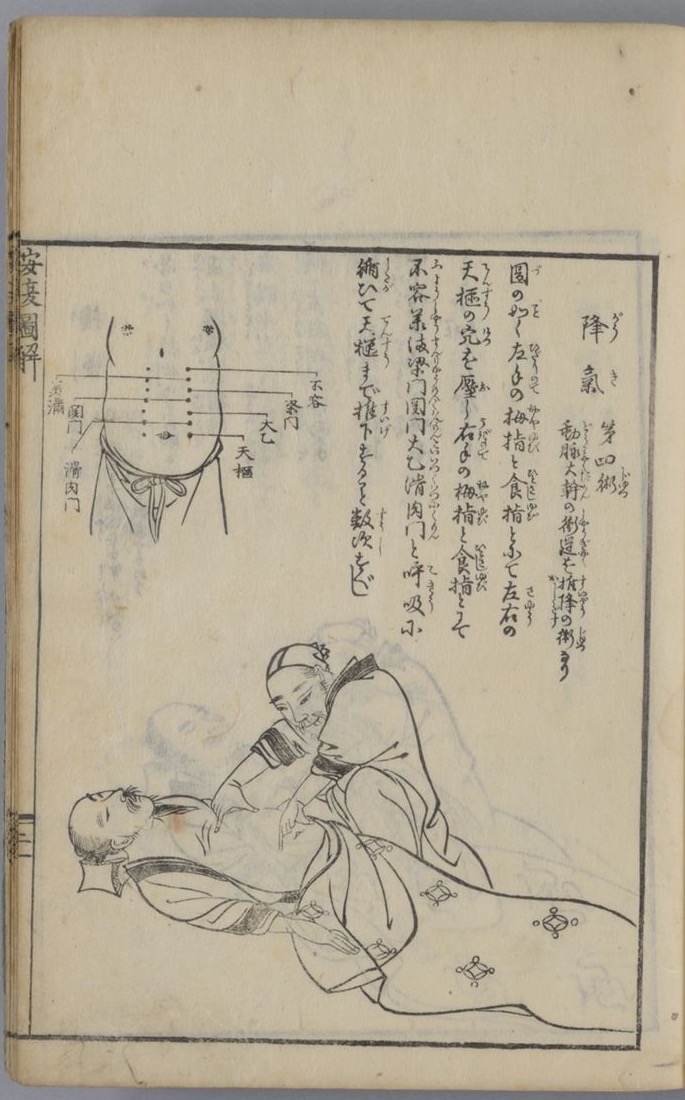
In 1827, near the end of the Edo period, Ōta Shinsai published an illustrated manual called Anpuku Zukai (按腹図解). Kyoto University holds a digitized copy. On the page below, a diagram marks points on the abdomen, and a second drawing shows a practitioner placing his fingers on the belly of a reclining person. A drawing can show where the hands are placed. The feel of the touch, and the judgment that goes with it, still have to be learned through practice. Kyoto University Rare Materials Digital Archive, Anpuku Zukai

Reiki’s journey from Japan
Reiki, now known around the world, also has roots in early twentieth-century Japan. In the 1920s, Mikao Usui developed the practice that became known as Usui Reiki Ryōhō. According to Reiki tradition, a retreat on Mount Kurama near Kyoto culminated in a spiritual experience that inspired his teaching. In Reiki practice, hands may rest on or hover above the body. Practitioners understand this gesture through a belief in an energy they call reiki. Justin B. Stein, Alternate Currents
One of Usui’s students, Chūjirō Hayashi, went on to teach Hawayo Takata, a Japanese American born in Hawaiʻi. Takata brought the practice to Hawaiʻi and taught it on the North American mainland. Her students helped carry it farther afield. Justin B. Stein, Alternate Currents
The gesture we return to
A boy trying to comfort his mother. An Edo-period author drawing where to place the hands. A practice that travelled across the Pacific. In each of these stories, a familiar gesture took a different form and was passed on.
At SÉREN Le Moment, both the products we use and our hands-on techniques draw on expertise developed in France. The care we feel for each guest comes through in small details, in the quiet moment when we first place our hands and in the way we adjust our pressure to the rhythm of their breathing. We value the warmth that comes from that care and can be felt through touch.
That same attentiveness runs through the Japanese traditions we’ve explored. When we rest a hand on a sore shoulder or hold someone’s hand when words are hard to find, the way we touch can convey how much we care. In the everyday Japanese word teate, we recognise something we value each time we welcome a guest.